Five Books About Conversing With Animals
How great would it be to talk with animals, through magic or technology or… whatever?
Five Books About Conversing With Animals
Eleanor Barraclough, Embers of the Hands: Hidden Histories of the Viking Age. Material goods/archaeological evidence in the study of this period. It's slightly awkwardly balanced in terms of who the audience is--I have a hard time that people who need this much exposition about the era will pick up a book this specifically materially detailed--but not upsetting in that regard.
Elizabeth Bear, Hell and Earth. Reread. Returning to my reread of this series in time to still have all the memories of what's been going on with Christopher Marlowe and William Shakespeare and their connections to faerie realms; as the second half of a larger story, it goes hard toward consequence and ramification from the very start of the volume.
Jerome Blum, In the Beginning: The Advent of the Modern Age: Europe in the 1840s. I feel like this is trying for more than it achieves. It goes into chapters about Romanticism and the advent of science and some other things, and then there's a second section with chapters about major empires. But what it doesn't do is actually talk about Europe in this period--it's fairly easy to find material about England, about France, even about Russia, but there's nothing here about Portugal or Greece or Sweden. It's not a volume I'm going to keep on the shelves for the delightful tidbits, because it's not a tidbit-rich book. Also some of the language is '90s standard rather than contemporary. So: fine if this is what you have but I think you can do better.
Ashley Dawson, Environmentalism From Below: How Global People's Movements Are Leading the Fight for Our Planet. Good ground-up Third World environmentalism thoughts.
Victoria Dickenson, Berries. One of my friends said, "a book about berries, Marissa would love that!" and she was absolutely right. It is lushly illustrated, it is random facts about berries, I am here for it.
Emily Falk, What We Value: The Neuroscience of Choice and Change. Interesting thoughts on working around one's particular brain processes--the third "c" that did not make the title is "connection," and there's a lot about how that can be used to live lives closer to our own values.
Margaret Frazer, Heretical Murder. Kindle. One of the short stories, and possibly the least satisfying one of hers I've read so far: there's just not room for questions, uncertainty, or even a very human take on the life experiences of heretics in this milieu. Oh well, can't win them all.
Jonathan Healey, The Blood in Winter: England on the Brink of Civil War, 1642. If you're an English Civil War nerd, this book on the lead-up to it will be useful to you. I am. It is.
T. Kingfisher, Snake-Eater. A near-future desert fantasy that was creepy and exciting and warm in all the right spots. This is one of Kingfisher's really good ones. Also Copper dog is a really good dog--I mean of course a good dog but also a well-written dog, a dog written by someone who has observed dogs acutely.
Olivia Laing, The Garden Against Time: In Search of a Common Paradise. Lyrical writing about gardening in the face of more than one apocalypse at the same time. Laing loves many of the same reference points as I do, in life, in literature, and in botany, so I found this a warmly congenial book.
L.R. Lam, Pantomime. This is very much the first volume in a series; its ending is a midpoint rather than an ending per se. It's a circus fantasy with an intersex and nonbinary protagonist, and it was written just over a decade ago--this is one of the books that had to exist for people to be doing the things with intersex and/or nonbinary characters that they're able to not only write but get published now.
Ada Limón, Startlement: New and Selected Poems. Glorious. Some favorites from past collections and some searing new work, absolutely a good combination, would make a good present especially for someone who doesn't have the prior collections.
Daniel Little, Confronting Evil in History. Kindle. This is a short monograph about philosophy of history/historiography, and why history/historians have to grapple with the problem of evil. I feel like if you're really interested in this topic there are longer, more thorough handlings of it, but it was fine.
Robert MacFarlane, Is a River Alive? Really good analysis of how we parse things as alive and having rights, and also how riverine biology, ecology, social issues are being handled. Personal to the right degree, balanced with broader information, highly recommended.
Lars Mytting, The Bell in the Lake and The Reindeer Hunters. The first two in a series of Norwegian historical fiction, not more cheerful than that genre generally is but more...active? relentless? I really like this, they're gorgeous, but people will die sad deaths, that's how this stuff does, it's just as well that I'm taking a break before reading the next one because too much of it can make me gloomy but just the right amount is delightful. The symbolism of the stave church and its bells and weaving and all the weight of rural Norway hits in all the right ways for me.
A.E. Osworth, Awakened. This queer millennial contemporary fantasy is not rep of me, it's rep of the people I'm standing next to a lot of the time, and that's powerful in its own way. Many of you are that person. This does things with magic/witch community that feel very true and solid, and it's a fun read.
Lev A.C. Rosen, Mirage City. The latest in the Evander Mills mysteries. This one takes Andy to Los Angeles and his childhood home, in pursuit of missing (queer) persons. Some of them turn out to be perfectly well, some of them...a great deal less so...but the B-plot was focused on Andy's relationship with his mother, whose job turns out to be something he didn't know about--and will have trouble living with. The last line of the book made me burst into tears in a good way, but in general this is a series that has a lot of historical queer peril, and if that's something that's going to make you more unhappy than otherwise, maybe wait until you're in a different place to try them. I think they continue to stand reasonably well alone.
William Shakespeare, King Lear. Reread. Okay, so at some point in early October I earnestly wrote "reread King Lear" on my to-do list for reasons that seemed tolerably clear to me at the time. Things on the list tend to get done. Somewhere in the last two months I forgot why this was supposed to get done. If there's a project it's supposed to inform, reading it has not helped me figure out which project that is. I'm not mad that I reread it, it still has the bits that are appalling in the most interesting ways, but...well. A mystery forever I suppose.
Martha Wells, Platform Decay. Discussed elsewhere.
Review copy provided by the publisher.
I got this in the mail today and immediately read it. Now, yes, it is December and my TBR is perilously small. But also: new Murderbot! Yay! Still delighted to see more of this series.
In this episode: Murderbot has installed code that allows/requires "emotion checks" periodically, so we get to see the self-awareness process evolve with that (and sometimes devolve...). Murderbot is also assisting with the extraction of several humans, including juveniles and an elder. Juvenile humans do all sorts of things that alarm, annoy, and in some cases terrify Murderbot. This is all to the good.
("Terrified" is never the response to an emotion check. Obviously. Like the kid in The Princess Bride, Murderbot is sometimes a bit concerned, that's all. Definitely only a bit concerned.)
Unfamiliar systems, unfamiliar humans, what else could be called for here...oh, wait, is it the consequences of Murderbot's own actions? WELP. Lots of fun. Still recommend. Don't start here, it's mid-ramification.


Which 2025 Clarke Award Finalists Have You Read?
Annie Bot by Sierra Greer
1 (4.5%)
Extremophile by Ian Green
0 (0.0%)
Private Rites by Julia Armfield
1 (4.5%)
Service Model by Adrian Tchaikovsky
14 (63.6%)
The Ministry of Time by Kaliane Bradley
14 (63.6%)
Thirteen Ways to Kill Lulabelle Rock by Maud Woolf
0 (0.0%)

Aside from Larry Correia, are there any big name Baen authors who debuted at Baen, after Jim Baen's death?
(So, Tim Powers wouldn't count because he debuted not at Baen and also long before JB died)

We've all heard it a million times: baking is precise and cooking is loose. Cooking is jazz, baking is classical. Cooking has room to improvise, but with baking you have to follow the recipe to the letter.
This is, of course, nonsense. For one thing, you can't control every variable every time. If baking required everything to be utterly precise, it would never work, because air temperature, pressure, and humidity all vary; you have to be able to work around those major variables. If it was true, you'd never see experienced bread bakers frown and throw another handful (or three) into the recipe. And most importantly, if this was true......how would we ever get new baked goods?
I think this is a mistake we make too often when we're thinking about bringing light into dark times for each other. We think of it has having to be precise and perfect for it to work. If we're not winning every struggle, we must be doing something wrong and should just quit. If we can't come up with the perfect phrasing to offer comfort to worried or grieving friends and neighbors, why even try? Maybe tomorrow we'll be warm and witty and precisely right. Or someone else can do it. Surely someone else has the right answer, and we can just use that.
So yeah, the lussekatter--you know what day it is--rose despite the plummeting temperature (and with it the plummeting humidity, oh physics why do you do us like this). They rose and rose and rose. Friends, they are mammoths. They are lusselejon this year. I forgot the egg glaze--I told you last year that I shouldn't mention that remembering it was unusual, and ope, it was an omen, I did not put egg wash on. They are still great. They are still amazing. What they are not--what they don't have to be--is perfect.
Last week one of my friends wrote to me to say that she'd made calzones but they'd turned out denser than usual. And you know what I thought? I thought, "Ooh, her family got calzones, I should make calzones one of these days!" And not in the "I'd do it better than that loser" way, either. Just: yay homemade calzones, what a treat. I watched her doing it. I remembered that I can do it too. Dense or not. Egg washed or not. Perfect or--let's be real, perfect isn't available, what we have is imperfect, and it turns out that's what we need. Lighting one imperfect candle from another, all down the chain of us, until the light returns.
2024: https://marissalingen.com/blog/?p=4078
2023: https://marissalingen.com/blog/?p=3875
2022: https://marissalingen.com/blog/?p=3654
2021: https://marissalingen.com/blog/?p=3366
2020: https://marissalingen.com/blog/?p=2953
2019: https://marissalingen.com/blog/?p=2654
2018: https://marissalingen.com/blog/?p=2376
2017: https://marissalingen.com/blog/?p=1995
2016: https://marissalingen.com/blog/?p=1566
2015: https://marissalingen.com/blog/?p=1141
2014: https://marissalingen.com/blog/?p=659
2013: https://marissalingen.com/blog/?p=260
2012: https://mrissa.dreamwidth.org/840172.html
2011: https://mrissa.dreamwidth.org/796053.html
2010: https://mrissa.dreamwidth.org/749157.html
2009: https://mrissa.dreamwidth.org/686911.html
2008: https://mrissa.dreamwidth.org/594595.html
2007: https://mrissa.dreamwidth.org/2007/12/12/ and https://mrissa.dreamwidth.org/502729.html
2006: https://mrissa.dreamwidth.org/380798.html — the post that started it all! Lots more about the process and my own personal lussekatt philosophy here!...oh hey, this is the twentieth year I've posted about this. Huh. Huh. Well, isn't that a thing.
Some thoughts about digital personalities in my work

(self-indulgent blather about my take on artificial digital beings, as I’ve written them)
I’ve been watching the latest AI developments with a somewhat…oh, what word do I want? Not jaded, not cynical, but definitely somewhere in between. Especially when I start reading about “AI Grandmas” and the use of that tech to speak to long-dead relatives. Oh, it’s presented with that same amber glossiness that seems to dominate the worlds of AI visual creations. But…we’re already seeing some of the dark side of these AI creations with reports of self-harm and worse coming from AI “personalities.”
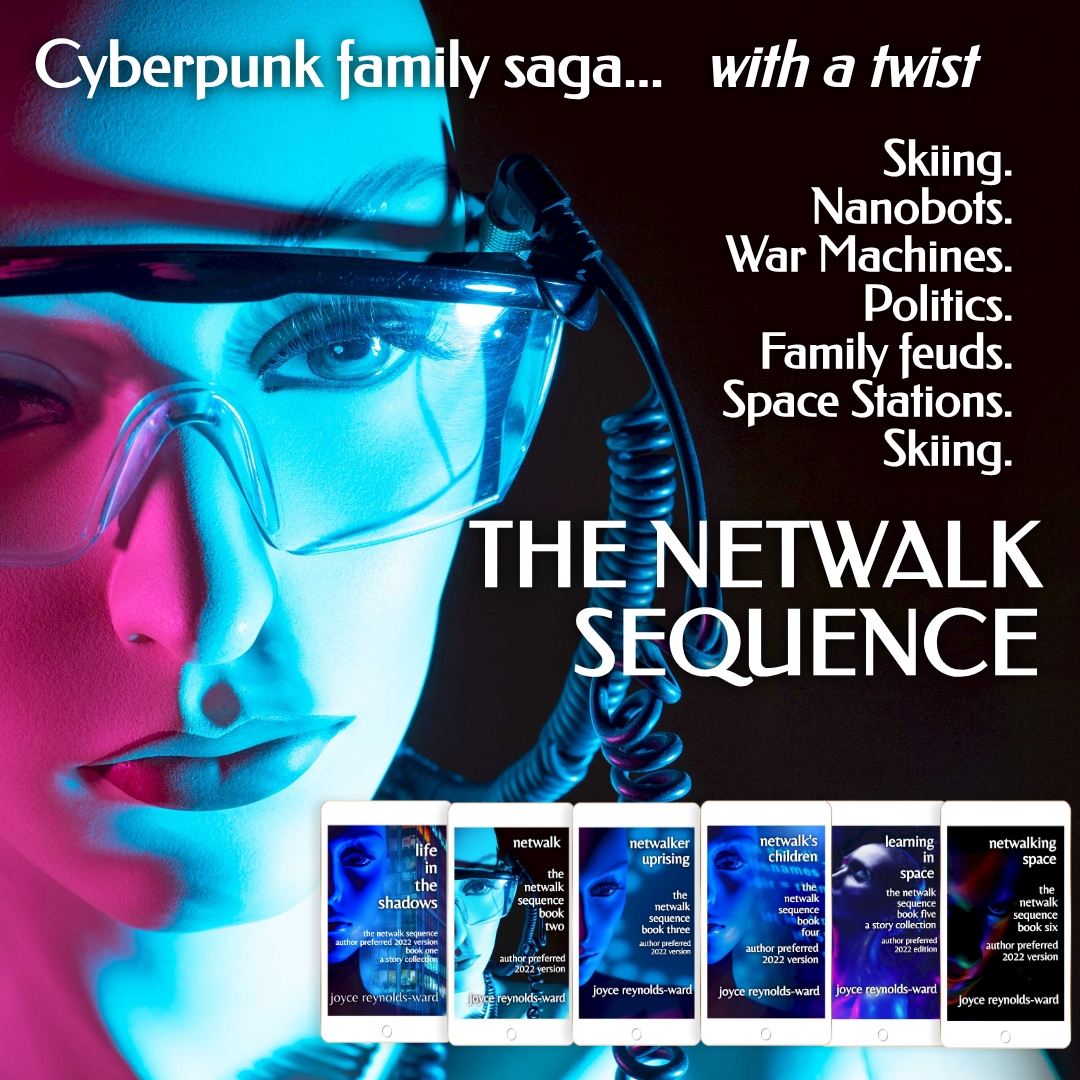
One reason for my attitude is that the creation of self-aware digital personalities is something I’ve somewhat explored in my work, most notably the Netwalk Sequence series and the Martiniere Family Multiverse Saga. In both cases, the tech I explore is already somewhat different from what we are seeing. I don’t go into the nuts and bolts of just how that self-awareness ends up happening (well, a little bit in the Martinieres). But nonetheless, I think this dynamic of what that really looks like is something very much overlooked in the current hype around “preserving the memories of your loved ones” in order to recreate them in a digital simulation. I can oh-so-easily see how it could turn bad.
What happens if AI Grandma is toxic? Or if AI Grandma develops sufficient self-awareness to start meddling in the affairs of her descendants? It’s entirely possible. And while AI Grandma might not have the ability with current tech to really muck up her descendants’ banking and financial history…there’s still a lot of damage she can do to living beings.
The Netwalk Sequence was my first exploration of just what the problems with a separate digital personality creation could end up being. I started building the Netwalk Sequence world back in the ‘90s, when digital personality uploads were somewhat the fashion in fiction and in theory.
My base assumption was that digital personalities could completely upload to the internet upon their death. In that world it’s entirely possible to be a complete personality online, with full body immersion, using the mechanism of a highly sophisticated wireless communication chip implant called Netwalk. Uploading came later, in the midst of a dramatic political struggle where an older leader—Sarah Stephens—uploaded upon her death and began to stalk and attack her opponents. The new development was called Netwalk, and the uploaded personalities called Netwalkers.
A restraint that I created in the Netwalk universe was that Netwalkers would go insane and turn predatory on living beings if completely cut off from sensory inputs. They would attack alive users of Netwalk in order to gain sensory exposures and recharge themselves—as well as fulfilling agendas and settling resentments that hadn’t been dealt with in life. In some cases this would end up as possession of the living being by the Netwalker. As a result, with the exception of a handful of rogues, Netwalkers ended up being tied to a living host, most specifically that host’s Netwalk chip. In the Sequence, we see is how this plays out within one powerful family, the creators and controllers of this technology. With some other dynamics thrown in as well—the control of a war machine of unknown origin which has some influence on the development of the original Netwalk, plus intensely weird family history that involves a lot of infighting and struggles over who controls what.
There’s no grudge like a family grudge, shall we say?
In the Martiniere Multiverse, I postulate something closer to our current concept of the “AI Grandma,” where videos and recordings lead to the creation of digital thought clones. Thought clone appearances in the Martiniere Multiverse aren’t constrained to computers and devices, however, and they can hop universes. This is somewhat connected to a magical Fae origin which is tied to a computer worm that can also skip through assorted multiverses.
The Martiniere digital thought clones (digis for short) differ from Netwalker personality uploads at death in that they are specifically digital constructs of a once-living personality, and only become activated upon specific actions by a living person who is keyed into the algorithm. The digis are fully aware that they are digital constructs and are not the uploaded personality of the dead person they’re modeled after.
Digis don’t appear in every Martiniere book. To follow their development chronologically in series order, start with The Enduring Legacy, the fourth book of the Martiniere Legacy series. We see Gabriel Martiniere’s first awareness of digis shortly before his death, when he ties the appearance of a dangerously destructive computer worm to specific holes in not just his memory but the memories of his closest family. Gabe takes the first steps to establish the bounds of his digi, with a specific activation algorithm tied to certain family members.
More details about digis and their creations happen in two of the Martiniere Legacy standalones, The Heritage of Michael Martiniere and Justine Fixes Everything: Reflections on Mortality. Heritage shows Gabe’s activation; Justine goes into further complications. However, the most details and the most explicit multiversal version appears in the three books of The Cost of Power: Return, Crucible, and Redemption.
Like Netwalkers, digis are capable of possessing living beings and bending them to their will. There are malign digis and beneficial digis. We only see them in the context of one, powerful family because, in both cases, the artificial entities serve as chess pieces in ongoing family battles. They are obstacles that need to be navigated and overcome by the protagonists.
(Sarah Stephens and Philip Martiniere would probably strongly disagree with me but—nothing says that they are pawns.)
Back in real life, Netwalk is probably not at all feasible, though digis…may be. Current technology doesn’t allow for digis to function the way I wrote them in the Martinieres, but some of the same issues raised by both Netwalk and digis still exist. The news has multiple examples of people being influenced by AI interactions to do harm, whether to themselves or others. Or of people who develop a strong emotional attachment to artificial beings to the detriment of their attachments to living beings.
Rather than the apocalyptic stuff I postulated in the Netwalk and Martiniere books, that’s the real harm in uncritical adoption of the creation of artificial beings. At what point do we slip from a clear awareness that “this is a creation; this is not real” to uncritical acceptance of these creations as real beings?
What happens if we start treating these AI creations as something above and beyond an artificial construct?
What rights will they have as opposed to living humans? Or lack of rights?
What happens if they turn malign, either due to the manner in which they are constructed or due to abusive treatment from living humans? Then what?
All food for thought.
Meanwhile, the artificial beings I created in my own worlds are definitely not your happy-happy AI Grandmas. And at times, I wonder if those imperfect visions of mine may end up reflecting an actual reality.
We shall see.